Chosen Out of Context

One Scripture passage that is occasionally used to support the idea that God chooses who will be saved is John 15:16. This is then quoted out of context “Ye have not chosen me, but I have chosen you.”  However, if taken in context it ONLY applies to the 11 Apostles and has nothing to do with being chosen for salvation.

At the Last Supper after Judas has already left to betray Jesus [John 13:1-4; 24-30], Jesus spoke to the eleven Apostles and said “Ye have not chosen me, but I have chosen you, and ordained you, that ye should go and bring forth fruit, and that your fruit should remain: that whatsoever ye shall ask of the Father in my name, he may give it you.

He is only speaking to the 11 Apostles. When did he choose the Apostles? Luke 6:12-17 tells exactly when they were chosen.

And it came to pass in those days, that he went out into a mountain to pray, and continued all night in prayer to God.  And when it was day, he called unto him his disciples: and of them he chose twelve, whom also he named apostles; Simon, (whom he also named Peter,) and Andrew his brother, James and John, Philip and Bartholomew, Matthew and Thomas, James the son of Alphaeus, and Simon called Zelotes, And Judas the brother of James, and Judas Iscariot, which also was the traitor.”

Jesus gathered all of his disciples together and chose from among them the 12 [of which one was a devil] to be Apostles.  They were chosen for a specific purpose and service. This does not support the view that only those God chooses can be saved.

The disciples were believers before Jesus chose them to be Apostles, they were not chosen TO BE saved, they were chosen to be Apostles, i.e. to serve in the capacity as Apostles


Does Babylon Need a Seaport?

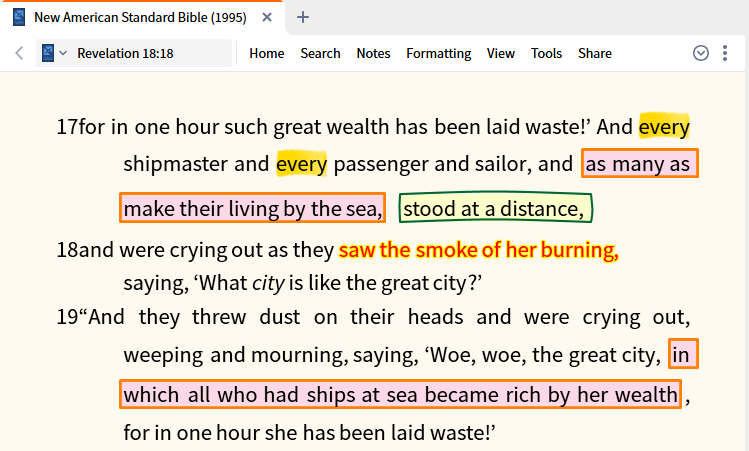
Many Bible and prophecy teachers insist that “Babylon the Great” in Revelation 18 must have a seaport for verses 17-19 to be fulfilled.

The primary argument given is that because it says the shipmasters, every passenger & sailors, and all who make their living by the sea stood at a distance and saw the smoke of her burning, of course they had to be in a seaport to do that, or at least close enough to see it happening.

Maybe a couple hundred years ago that would be the only possible way a person could conceive of this happening. However, we know that today, the entire world could see the smoke of her burning from any distance on a number of different electronic devices–and in real time!

Woe, woe, the great city, in which all who had ships at sea became rich by her wealth.” Clearly, it isn’t only talking about the people in the ships, but every one that was involved in the shipping business.

Notice it says “Every shipmaster, all the passengers & sailors, all who make their living by the sea. Think about that for a minute, so all of them from the whole Earth are in the Seaport at one time? No, because at any given time, ships would be all around the Earth. They would never be in or near the same seaport at the same time.

Let’s look at the broader context:

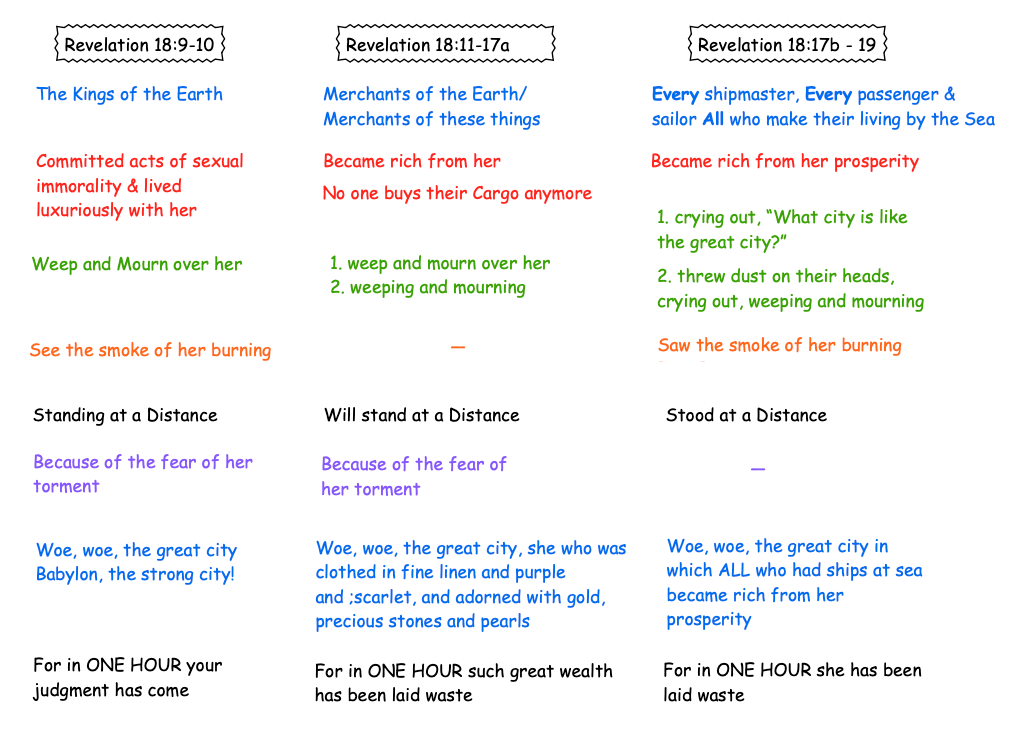
Verses 17-18 don’t stand by themselves, they literally stand with two other groups that are described first.

  • The kings of the Earth
  • The merchants of the Earth who stand along with every shipmaster, passenger, sailor and all those who trade by the sea are standing at a distance

The comparison chart shows that all three groups witnessed the same event from a distance:

Notice the kings of the Earth and the merchants of the Earth were standing at a distance. They wouldn’t usually be in ships in a seaport. The kings of the earth and the merchants of the Earth would be all around the world. Yet, all of them are said to be standing at a distance.

The immediate and broader context doesn’t require a seaport and it would be impossible for all who are mentioned to be in the vicinity of Babylon the Great. This assumption was made without any supporting Biblical evidence. Babylon does not need a seaport for Revelation 18 to be fulfilled.


Is Salvation Simply an “Admit One” Ticket to Heaven?

“You make choices, and you live with them.” Phil “Groundhog Day”

We have always had the freedom of choice, but no one has ever had the freedom to choose the results or consequences of those choices. Life, unfortunately, or maybe fortunately, does not work like Groundhog Day. We do not have the ability (or the opportunity) to go back in time and make a different choice, no matter how much we wish it were possible.

Salvation isn’t simply an “Admit One” ticket to Heaven that you can lose or give back, it is a free-will choice with eternal consequences. “Consequence” means a result or effect of an action or condition. This word usually has a negative connotation. But in general, it simply means what results from a particular choice or action.

How many choices in your life do you regret and wish you could go back and change. Or, are there choices that you are happy with? Maybe a choice that protected you from disaster? Good or bad, these are all irrevocable choices and the results of these choices cannot be undone.

Adam and Eve were faced with a choice—to eat of the fruit of the tree of knowledge of good and evil, or to obey God and not eat of it. They made an irrevocable choice, and of their own free will they chose to eat of the fruit.

They had been warned of the consequences — that they would surely die. Several things occurred because of their choice. They died immediately spiritually and began dying physically. To the woman God said, “I will greatly multiply thy sorrow and thy conception; in sorrow thou shalt bring forth children; and thy desire shall be to thy husband, and he shall rule over thee.

To the man God said, “cursed is the ground for thy sake; in sorrow shalt thou eat of it all the days of thy life; Thorns also and thistles shall it bring forth to thee; and thou shalt eat the herb of the field; In the sweat of thy face shalt thou eat bread, till thou return unto the ground; for out of it wast thou taken: for dust thou art, and unto dust shalt thou return.

Additionally, the entire creation became corrupted and is waiting to be regenerated, as Paul indicates in Romans 8:9-22 “For the eagerly awaiting creation waits for the revealing of the sons and daughters of God. For the creation was subjected to futility, not willingly, but because of Him who subjected it, in hope that the creation itself also will be set free from its slavery to corruption into the freedom of the glory of the children of God. For we know that the whole creation groans and suffers the pains of childbirth together until now.

There was nothing Adam and Eve could do to reverse the consequences of their free-will choice. They could not go back in time and make a different choice, and they could not change the consequences of their choice.

A similar situation occurs when you are presented with the Salvation Gospel. You can make a choice to receive the free gift of Salvation, or you can choose to reject it. You can reject it over and over again, but at some point, you will reject it for the last time and will reap the consequences of that choice, and you will not be able to go back in time and make a different choice.

However, you can instead, of your own free will, make the choice to receive the free gift of Salvation, but just like Adam and Eve’s choice, it cannot be undone, because there are certain things that occur when you accept the free gift of Salvation. These results are all accomplished by God. We cannot do any of this ourselves and we also cannot undo anything that God does. As Paul says in Romans 11:29 — “The gifts and calling of God are irrevocable.

The following things occur the moment we believe and put our trust in the finished work of Jesus Christ:

We are Born Again [John 3:1-9;]: We are born again by the Spirit. We are “being born again, not of corruptible seed, but of incorruptible, by the word of God, which liveth and abideth for ever.” [1 Peter 1:3,23] Incorruptible means “unperishable.” When we are born again we cannot perish, because we are born of incorruptible/unperishable seed.

Being born cannot be reversed, you can’t go back in time and prevent yourself from being born. Just as there is nothing you can do can change the fact that you were born from your biological parents, there is nothing you can do to change the fact that you were born again spiritually and have become a child of God [John 1:12-13].

We are a New Creation [2 Cor. 5:17; Gal. 6:15]: When we are born again, we are a new creation. A new creation cannot become “uncreated.” A new creation is something that never before existed, so you cannot become uncreated. For that to occur, you would have to go back in time and change it. There isn’t anything in the entire creation of God that can become uncreated.

We are “In Christ” [1 Cor. 12:13; Rom. 8:1; Rom. 16:7; 1 Cor. 1:30; 2 Cor. 5:17] : We are baptized [placed] into and become part of the body of Christ which is the Church, and we who have accepted the free gift of Salvation are described by Paul as being “in Christ.”

The Holy Spirit Indwells Us [John 14:16-18; 1 Cor. 6:19; 2 Tim. 1:14; ]: The Holy Spirit indwells us permanently. God promised that the Holy Spirit will never leave us. When we got saved, did we put the Holy Spirit in us? No, God did that. To become “unsaved,” the Holy Spirit would need to leave us. We cannot remove the Holy Spirit any more than we could put Him there in the first place.

We are Sealed by the Holy Spirit [Ephesians 1:13-14; Ephesians 4:30]: We are Sealed by the Holy Spirit UNTIL the redemption of our physical body. The fact of being sealed cannot end before the redemption, it can only be fulfilled by the redemption. “Until” doesn’t leave a gap where something else can occur in-between the two events. You cannot become unsealed. God sealed us through His Holy Spirit and we cannot reverse what God does.

We now Posses Eternal Life [John 3:36; John 5:24; John 6:47]: We have passed from death unto life. We possess Eternal Life now. You cannot lose Eternal Life, because if you did, it wasn’t Eternal Life, it was only life for a period of time. Eternal Life is a gift of God. And the gifts and calling of God are IRREVOCABLE! [Romans 11:29]. If we didn’t receive Eternal Life until after we have physically died. Then there would be a possibility, because it would be a future gift, but Jesus makes it very clear that we have already passed from death unto life.

We have been Redeemed [Acts 20:27-28, Galatians 4:4-5, Ephesians 7:7, Hebrews 9:12]
Jesus purchased us with his blood. We cannot change that. We permanently belong to Him. As Hebrews 9:12 states, “Neither by the blood of goats and calves, but by his own blood he entered in once into the holy place, having obtained eternal redemption for us.”

We have been “Declared Righteous”—A Judicial Position [Romans 5:9]: We are Justified — “Declared Righteous.” This is NOT affected by the sins or any actions of our past, or the sins or any actions that we will do in the future. Nor is it affected by the good things we do. It is a judicial position. We have been declared Righteous by God, we cannot change this. It is not based on what we did, or what we do or don’t do, it is ONLY based on what Jesus did. He paid the price of Salvation and gives it freely to all who believe/receive Him.

Being saved is not just being given a “Get out of Hell free card” or a free ticket to Heaven that says “Admit One” that you can loose or give back. There are unchangeable consequences/results of your free will choice to believe and trust in Jesus’ finished work of paying for all the sins of the world which is irrevocable and you cannot go back in time to reverse it. You cannot lose or even give back the free gift of Salvation.


The Demise of Damascus

Isaiah 17 describes the destiny of Damascus being taken away from being a city.  Has this prophecy been fulfilled?  Watch this presentation by Dolores McCrory.

To watch the presentation click here:  The Demise of Damascus


Psalm 83 War

The Magog Invasion of Ezekiel 38-39 is discussed a lot and is well known, but have you ever noticed that the countries involved do not include any of the countries that border Israel? Considering the threats from the bordering countries, you would think they would be involved.  Could something happen before the Magog Invasion which takes them out of the equation?

The answer is that the Psalm 83 War involves all of the bordering countries and results in Israel’s borders being greatly expanded.

The recent events in Israel with Hamas has increased interest in how this may be the beginnings of the Psalm 83 war.  Dolores McCrory created the following presentation in 2013, but much of it is relevant to what is happening right now. To watch the presentation, click on the link below.

The Psalm 83 War


Is the Sealed East Gate a Fulfillment of Prophecy?

A number of Bible prophecy teachers believe that the eastern gate on the Temple Mount in Israel is sealed shut as a fulfillment of the prophecy in Ezekiel 44:1-3. However, there are two main reasons why this is impossible. Taken in context, this passage refers to the eastern gate of the Millennial Temple complex, which is one square mile — it would not fit on the comparatively tiny Temple Mount. Secondly, the eastern gate will be sealed after the glory of the Lord enters through it, not before.

Ezekiel chapters 40-48 describe the future Millennial Temple. In Ezekiel 43:1-4, Ezekiel watched the glory of the Lord enter through the eastern gate of the Millennial Temple — at this point the gate is open.

“1 Then he led me to the gate, the gate facing east; and behold, the glory of the God of Israel was coming from the way of the east. And His voice was like the sound of many waters; and the earth shone from His glory. And it was like the appearance of the vision which I saw, like the vision which I saw when He came to destroy the city. And the visions were like the vision which I saw by the river Chebar; and I fell on my face. And the glory of the Lord entered the house by way of the gate facing east. And the Spirit lifted me up and brought me into the inner courtyard; and behold, the glory of the Lord filled the house.” [Emphasis Mine] [NASB]

Then later, in Ezekiel 44:1-3, Ezekiel is brought back to the eastern gate, and it is shut. At this point God tells him:

“This gate shall be shut; it shall not be opened, and no one shall enter by it, for the Lord God of Israel has entered by it; therefore it shall be shut.” [Emphasis Mine] [NASB]

This is referring to the previously mentioned eastern gate, which was open when the glory of the Lord entered by it. It was closed after the glory of the Lord had entered through it. Again, this is a future prophecy that cannot occur until the Millennial Temple is built. Therefore the eastern gate spoken of by Ezekiel doesn’t even exist yet.

From this we can determine that the sealing shut of the eastern gate on the Temple Mount is not a fulfillment of Bible prophecy.


Never Perish!

According to the Society of Evangelical Arminians, the view that “Salvation cannot be lost by accident, but it can be forfeited by deliberate choice and walked away from,”1 is the view of many Arminians.

John 10:28 is used to make the point.  However, focus is only given to the last part of verse 28 and the beginning of verse 29: “…neither shall any man pluck them out of my hand.  My Father, which gave them me, is greater than all; and no man is able to pluck them out of my Father’s hand…. [KJV]

They point out that, yes, no one can “snatch” them out of the Father’s hand or the Son’s hand, but the truly saved person could still choose to walk out of God’s hands by themselves, rejecting God and His Salvation.

However, this is taking it out of context. If you back up even slightly you will see that choosing to reject your Salvation isn’t even a possibility.  Starting with the beginning of verse 27:  My sheep hear my voice, and I know them, and they follow me: And I give unto them eternal life; and they shall never perish, neither shall any man pluck them out of my hand…”

Even the English word “never” does not allow for any exceptions.  It can never happen, His sheep will never perish. More importantly, what does the Greek say?  It is interesting to see that the English word “never” is used to translate more than one Greek word.  It is actually translated from five Greek words:

οὐ μή εἰς τὸν αἰῶνα,

Literally “not, not in the age.”  In English we might say something like “not in a million years!”  That doesn’t mean it might happen at some point, it means it will never happen.

A Greek sentence can be negated by one of two words, οὐ or μή, depending upon the grammatical structure.  However, unlike English, where two negatives cancel each other out making a positive, a double negative in Greek strengthens the negation exponentially.  So οὐ μή doesn’t just mean “not” it means “absolutely not, and the phrase “εἰς τὸν αἰῶνα” means “forever,” so, altogether it means “absolutely not forever.”

The Greek word translated “Perish” is “ἀπόλλυμι” and it means to be destroyed or die.  So, His sheep will absolutely not ever be destroyed/die.  This is strong enough in and of itself, but as Buist M. Fanning writes in William Mounce’s Basics of Biblical Greek Grammar, it is further strengthened by the fact that…

…it is the use of the two negatives οὐ μή with a subjunctive verb to indicate a strong negation about the future. The speaker uses the subjunctive verb to suggest a future possibility, but in the same phrase he emphatically denies (by means of the double negative) that such could ever happen. This linguistic combination occurs about eighty-five times in the New Testament, often in significant promises or reassurances about the future…

“…It would have been enough to have οὐ with a future indicative verb here, but Jesus is more emphatic. The subjunctive combination strongly denies even the possibility that any of Jesus’s sheep would perish: “they will certainly not perish,” “they will by no means perish,” is the sense of Jesus’s assertion. This is reinforced by the addition of the phrase εἰς τὸν αἰῶνα, “forever.” 2 [emphasis mine]

Jesus’ statement in John 10:28 is unambiguous and cannot be misunderstood or misconstrued.  The conclusion is clear: it is impossible for the genuine saved believer to ever lose or even give back his or her Salvation. 

___________________________________

1 Jackson, Kevin, Can Salvation be Lost? Society of Evangelical Arminians, 11-17-2008. Web.
http://evangelicalarminians.org/can-salvation-be-lost/
2 Fanning, Buist M. qtd. in “Basics of Biblical Greek Grammar” 4th Ed, p 352. Print.


Who Wrote the Book of Hebrews? —You Decide.

2 Thessalonians 3:17-18

The salutation of Paul with mine own hand, which is the token in every epistle: so I write.

The grace of our Lord Jesus Christ be with you all. Amen.

Romans 16:24

The grace of our Lord Jesus Christ be with you all.  Amen.

1 Corinthians 16:21 & 23

The salutation of me Paul with mine own hand…The grace of our Lord Jesus Christ be with you.

2 Corinthians 13:14

The grace of the Lord Jesus Christ, and the love of God, and the communion of the Holy Ghost, be with you all. Amen.

Galatians 6:18 

Brethren, the grace of our Lord Jesus Christ be with your spirit. Amen.

Ephesians 6:24

Grace be with all them that love our Lord Jesus Christ in sincerity. Amen

Philippians 4:23

The grace of our Lord Jesus Christ be with you all. Amen

Colossians 4:18

The salutation by the hand of me Paul.  Remember my bonds.  Grace be with you. Amen

1 Thessalonians 5:28

The Grace of our Lord Jesus Christ be with you. Amen

1 Timothy 6:21

Grace be with thee. Amen.

2 Timothy 4:22

Grace be with you, Amen.

Titus 3:15

Grace be with you all. Amen.

Philemon 1:25

The grace of our Lord Jesus Christ be with your spirit. Amen.

Hebrews 13:25

Grace be with you all. Amen.


The Biblical Case for the Location of the Temple: Part 3

Out of the city of David?

A verse that is often quoted by critics which they believe refutes the idea that Solomon’s temple was built in the city of David is 2 Chronicles 5:2 (Also 1 Kings 8:1):

Then Solomon assembled the elders of Israel, and all the heads of the tribes, the chief of the fathers of the children of Israel, unto Jerusalem, to bring up the ark of the covenant of the Lord out of the city of David, which is Zion.

The inference they make from this verse, (taken out of context by the way), is that it had to be taken out of the city of David in order to be brought into the newly built Solomon’s Temple in another location. However, I don’t think they fully realize the implications of this interpretation, because the Bible makes it very clear that the city of David and Jerusalem are two names for the same geographical location. [See: The Biblical Case for the Location of the Temple, Part 1So, if it was taken out of the city of David, it was taken out of Jerusalem making the Temple to have been built OUTSIDE of Jerusalem which contradicts a multitude of Scriptures throughout the Bible which say that the temple was in Jerusalem.

How did the ark get in the city of David?

In 1 Samuel 4, the Elders of Israel had the ark brought from Shiloh to where they had set up camp to go against the Philistines in battle.  Since God had not instructed them to do that, the Philistines massacred the Israelite army and the Philistines captured the ark.

The Philistines put the Ark in the house of Dagon, the fish god, and some unpleasant events followed during the seven months they were in possession of it, so when they had enough, the Philistines put it on a cart and sent it off on its own.  It went to Beth-shemesh which then sent messengers to the inhabitant of Kirjath-jearim to tell them to come and get the ark. [1 Samuel 5 and 6]

The men of Kirjath-jearim then came and got the ark and brought it to the house of Abinadab and sanctified his son Eleazar to keep the ark.  It stayed there for twenty years, during which the house of Abinadab was greatly blessed.  [1 Samuel 7:2]

Hearing how well the house of Abinadab had done with the ark located there, David tried to move the Ark to the city of David, but he didn’t do it properly and Uzziah was killed when he touched the ark.  So David was afraid to bring it to the city.  It remained with the family of Obed-edom for three more months.  [2 Samuel 6 and 1 Chronicles 13]

After awhile David decided to try again, only this time he did it correctly.  He first prepared a place for the Ark and pitched a tent for it.  He gathered all Israel together to Jerusalem to bring up the Ark  unto the place that he had prepared for it.  He did it right this time and had the Levites bring it to the city of David.  [1 Chronicles 15 ]

They brought the Ark and set it in the midst of the tent that David had pitched for it, and they offered burnt-sacrifices and peace-offerings before God. [1 Chronicles 16:1.]

David assigned Asaph and his brethren to minister by the ark (1 Chronicles 16:37) and Zadok the priest and his brethren stayed at the Tabernacle of the Congregation (which Moses had made in the wilderness) in the high place that was at Gibeon which was approximately 6 miles away. (1 Chronicles 16:39)

Both accounts in 2 Samuel 6:12 and 1 Chronicles 15:29; 16:1 state that the Ark was brought into the city of David and set in its place in the tent that David had prepared for it.

This makes it very clear that the ark indeed was kept in the city of David.  2 Chronicles 1:4 summarizes the entire event but states that David pitched a tent for it AT JERUSALEM:

But the ark of God had David brought up from Kirjath-jearim to the place which David had prepared for it: for he had pitched a tent for it AT JERUSALEM.

Years later, when Solomon was king, he went to Gibeon to sacrifice there and gave a thousand burnt-offerings on the altar.  That night, while still at Gibeon, he had the famous dream where God told Solomon to ask him for anything, and Solomon asked for wisdom to rule the people of Israel.  When Solomon woke up “he came to JERUSALEM, and stood before the ark of the covenant of the LORD and offered up burnt-offerings, and offered peace-offerings, and made a feast to all his servants.” (1 Kings 3:15)

The above verses show that the city of David and Jerusalem were one in the same and that the Ark was located there.  [in Jerusalem / the city of David]

So, why did they have to take the ark out of the city of David / Jerusalem?

The answer is found by reading the verses that follow in 2 Chronicles 5:1-7 [also 1 Kings 8:1-6.]

Then Solomon assembled the elders of Israel, and all the heads of he tribes, the chief of the fathers of the children of Israel unto Jerusalem, to bring up the ark of the covenant of the LORD out of the city of David, which is Zion. [2 Chronicles 5:2]

First, all of the men of Israel and the elders of Israel assembled for the feast which was in the seventh month called Ethanim, now known as Tishri. [verses 3 & 4]  and once assembled the Levites picked up the Ark and took it out of the city of David / Jerusalem in the correct manner and walked approximately 6 miles to the high place at Gibeon where the Tabernacle of the Congregation that was made in the wilderness was located, and they gathered up the Tabernacle and all the holy vessels that were in the tabernacle [verse 5] and the whole processesion went to a location [not specified*] where there was room for the whole group including all of the sheep and oxen they sacrificed which could not be told nor numbered for the multitude. [verse 6]  They could not gather inside of the city of David / Jerusalem because it was only a 12-acre piece of land which would have houses and other buildings needed for a city.

Then, after all of the sacrifices were concluded, “the priest brought in the ark of the covenant of the LORD unto his place, to the oracle of the house into the most holy place, even under the wings of cherubim.” [verse 7]

Solomon’s Temple was built in the city of David / Jerusalem, over the threshing floor that David purchased from Ornan the Jebusite, which makes it impossible for it to have ever been on the “so-called” Temple Mount, because it would have been outside of the geographical location called Jerusalem.

_____________________
*As to the unspecified location of the sacrifices, I think it is natural to assume that since the Temple was completed, they would sacrifice on the altar provided in the Temple.  The people would all be gathered in the Kidron Valley, but since the Bible doesn’t specify, we can only make educated guesses.


Bob Cornuke Responds to Criticism of his book “Temple”

Bob Cornuke refutes with evidence the criticism presented in a video of David Regan and Randall Price where they claim that:

  1. The drawings shown in the book are not “to scale”
  2. The size of the temple is wrong
  3. The size of the Roman Fort is wrong
  4. There IS water on the Temple Mount
  5. You can’t see the city of David from the Mt. of Olives

And more…


SaveSave

SaveSaveSaveSave

SaveSave

SaveSave