What is Centering/Contemplative Prayer?

The terms Centering Prayer and Contemplative Prayer are becoming well known in Christian circles.  For the most part, these terms have been used interchangeably.  However, Centering Prayer appears to be the methodology which creates the “spiritual” environment for Contemplative Prayer which is defined as contemplating God with the soul, NOT with your mind or rational thought.

Centering Prayer/Contemplative Prayer was brought into the Roman Catholic Church in 1977 by three trappist monks:  (Abbot) Thomas Keating, William Meninger, Basil Pennington.  This was in response to Vatican Council II’s call for “the revitalization of the path of contemplative prayer”

These three joined with ecumenically oriented Catholic theologians, an Eastern Zen master who offered retreats on Buddhist meditation and a former trappist monk who taught transcendental meditation.  Together they created “centering prayer.”

In the forward to the book Kundalini Energy and Christian Spirituality by Philip S. Romain, Thomas Keating (the most famous of the three trappist monks) wrote:

“Reading the Christian mystics from the perspective of his [Philip St. Romain] own experience of kundalini energy, the author sees many examples of its working in the lives of Christian saints and mystics. Since this energy is also at work today in numerous persons who are devoting themselves to contemplative prayer, this book is an important contribution to the renewal of the Christian contemplative tradition. It will be of great consolation to those who have experienced physical symptoms arising from the awakening of kundalini in the course of their spiritual journey, even if they have not experienced it to the fullest extent described by the author. His [Philip St. Romain] compelling testimony is a powerful affirmation of the potential of every human being for higher states of consciousness.”3

See Full Text of Forward

Although its proponents will argue against it, Centering/Contemplative Prayer IS most definitely a form of Eastern Meditation, i.e. Mystical Meditation.  Below is a comparison between what is taught by the New (Age) Spirituality and the method of meditation that is taught for Centering/Contemplative Prayer:

Mystical Meditation
Centering / Contemplative Prayer
Sit comfortably, with your eyes closed and your spine reasonably straight
Sit comfortably with your eyes closed
Choose a mantra and repeat it silently
Choose a sacred word or phrase and introduce it silently
If and when you notice that your attention has drifted completely off the mantra, gently begin repeating it again, and continue with minimal effort
Whenever you become aware of anything (thoughts, feelings, perceptions, images, associations, etc.) simply and gently return to your sacred word  (This obviously results in repetition of the word)
The intended Goal:  become enlightened, knowing truth by experience and ultimately “ascension” – which is self-realization, knowing that “I am divine”
The intended Goal:  To reach “The Silence” when all distracting thoughts are gone, a thin place where the spiritual barrier is the thinnest, where you can contemplate God with your soul NOT with your intellect.

As you probably noticed, the steps taken are identical.  Both use the same method to induce an altered state of consciousness – void of thought, just contemplating spiritual truth in an experiential fashion and accepting it as truth without discernment.  This is a spiritually dangerous condition.  The door to the spiritual realm of intense experience becomes the basis for truth instead of the Word of God.

Works Cited

3Philip St. Romain, Kundalini Energy and Christian Spirituality: A Path to Growth and Healing, pp.7, New York: The Crossroads Publishing Company, 1994.


The Origins of Centering/Contemplative Prayer–Kundalini

The following is a forward written by Thomas Keating, one of three Trappist Monks who created the modern centering/contemplative prayer.  He asserts that kundalini can be awakened by contemplative prayer practiced by Christians and indicates this is a positive thing.

Kundalini is an occultic energy or power which is the basis of all occultic belief systems, most notably Yoga.  Kundalini or the “serpent power” is believed to be coiled at the base of the spine in the first Chakra and through meditative techniques can be released and rise through each Chakra until it reaches the last where the practicioner attains psychic powers and self realization that he/she is god.

Along the way he/she also experiences numerous physical manifestations such as spontaneous singing, reciting mantras, animal sounds, uncontrollable trembling and shaking, spontaneous uncontrollable movement from yoga posture to yoga posture, waves of bliss, elation, altered states of consciousness, aches, anxiety, and feeling of heat flashes.

It can also be awakened instantly by the touch to the forehead by a guru which is a method called Shaktipat.

All occultic practices are forbidden by God throughout the Bible, most notably in the passage of Deuteronomy 18:10-12 which is a virtual encyclopedia of occultic practices which God states are “an abomination unto the LORD.”


The origins, eastern meditative methods, and occultic supernatural results of Centering/Contemplative Prayer should be enough to convince any true believer that this something to steer clear of and isn’t a legitimate method of true prayer, but a camouflagued occultic practice intended to deceive.


The following is the Forward written by Thomas Keating (one of the founders of Centering/Contemplative prayer) to the Book “Kundalini Energy and Christian Spirituality” by Philip St. Romain:

“This book is the first description that I know of in Christian literature about the awakening of kundalini energy in a purely Christian context.  Kundalini has long been known in Taoist, Hindu, and Buddhist spirituality.  The fact that this complete awakening occurred in the context of a classical development of Christian prayer makes it an important contribution to East/West dialogue.  Given the newness of the kundalini experience in Christian circles, however, any theological interpretation is bound to be tentative.

Reading the Christian mystics from the perspective of his own experience of kundalini energy, the author sees many examples of its working in the lives of Christian saints and mystics.  Since this energy is also at work today in numerous persons who are devoting themselves to contemplative prayer, this book is an important contribution to the renewal of the Christian contemplative tradition.  It will be a great consolation to those who have experienced physical symptoms arising from the awakening of kundalini in the course of their spiritual journey, even if they have not experienced it to the full extent described by the author.  His compelling testimony is a powerful affirmation of the potential of every human being for higher states of consciousness.

The awakening of kundalini energy and its various stages clearly enhances our understanding of how the body takes part in the spiritual journey.  Spiritual writers of our tradition have long known that the body must be carefully prepared if it is to receive the higher communications of divine grace.  For example, St. John of the Cross considered bodily ecstasy a weakness that gradually subsides in the process of transformation.

With keen insight, the author raises several crucial questions that arise from his experience of the full unfolding of kundalini.  Prior to the awakening of kundalini he received the Baptism in the Spirit and enjoyed the gift of tongues.  While appreciating the immense value of kundalini, he sharply distinguishes it from the action of the Holy Spirit.  He considers kundalini a natural evolutionary energy inherent in every human being.  There is a tendency in Hindu spirituality to identify kundalini and the Holy Spirit, perhaps because the Baptism in the Spirit is not a part of the experience of the East.

Kundalini is an enormous energy for good, but like all human potentials, it could also be used for selfish motives and thus become a source of serious harm.  This is probably the energy that is so attractive in cult leaders; they may well impart a spiritual experience through the transmission of kundalini in a way that we do not yet understand.  Energy, however great, is only energy,.  It is how one uses it that counts.  Thus the importance of the moral context in which kundalini is awakened.  Most spiritual disciplines worldwide insist on some kind of serious discipline before techniques of awakening kundalini are communicated.  In Christian tradition, the exercise of the moral virtues that quiet emotional turmoil, the service of others, and the regular practice of the stages of Christian prayer from discursive meditation to contemplation are the essential disciplines.  Without such positive preparation and the passive purifications described by St. John of the Cross, kundalini could serve the purposes of the false self and be used for spiritual power plays, to the great emotional and spiritual damage of other people.  Thus, for a Christian at least, it is essential that the Holy Spirit direct their energy.  In Christian spirituality, the unfolding of the stages of prayer described by St. Teresa of Avila in the Interior Castle may be the fruit of the kundalini energy arising under the guidance of the Holy Spirit.  Kundalini may also be an active ingredient in the Dark Nights of St. John of the Cross.

Kundalini has influenced ancient Eastern methods of medicine such as acupuncture and ayurvedic medicine.  As these forms of healing become better known in the West, the question as to the exact nature of kundalini will certainly arise.  All the Eastern traditions concur that this energy should not be awakened except under the guidance of a qualified teacher.  Since this energy can arise through the practiced of ordinary Christian prayer forms, the need of spiritual directors who are at least knowledgeable in this area is evident.  The personal predicament that the author describes could be happening to other Christians in our time.  Moreover, as Christian contemplation becomes better known, a number of persons who have experience the awakening of the kundalini through Eastern techniques may wish to return to their Christian roots, where their spiritual condition needs to be understood.

In order to guide persons having this experience, Christian spiritual directors may need to dialogue with Eastern teachers in order to get a fuller understanding.  The importance of the “Document on the Non-Christian Religions” comes into focus here.  The document states, “the Church therefore has this exhortation for her sons[and daughters]; Prudently and lovingly through dialogue and collaboration with the followers of other religions and in witness of Christian faith and life, acknowledge, preserve and promote the spiritual and moral goods found among these men and women] as well as the values in their society and culture.”  (no.2)

This book will initiate Christians on the spiritual journey into this important but long neglected dimension of the transforming power of grace.”

END OF FORWARD


Is Contemplative Prayer Biblical Prayer?

In 2 Corinthians 2:11, Paul takes it for granted that the Corinthians are “not ignorant of his (Satan’s) devices.” Sadly, a large portion of the church today appears to be vastly ignorant of Satan’s devices.

Deuteronomy 18:10-11 gives a list of occult or pagan practices which are an abomination to God. Many of these have been disguised by being given positive-sounding names or simply adding the word “Christian” to them such as “Christian Yoga” in effect producing “Christianized Abominations.”  One such practice is called centering or contemplative prayer, which isn’t prayer at all, but mystical meditation

What is the Biblical definition of prayer?
There are a number of different words translated “pray” “praying” or “prayer” in the New Testament Greek.  Many of which simply mean to make a request of either man or God.  Two of these are “Eratao” and “Deomae.”

“Erotao” ἐρωτάω is a verb that simply means to ask, request, beg.   It is used in passages such as Luke 5:3And he entered into one of the ships, which was Simon’s, and prayed him that he would thrust out a little from the land.  And he sat down, and taught the people out of the ship.”  (John 17:15; Acts 10:48; 1 John 5:16 and many others)

“Deomae” δέομαι is a verbal/gerund which means–wanting, desiring, asking, begging, beseech, make requests.”  2 Corinthians 8:4Praying us with much entreaty that we would receive the gift, and take upon us the fellowship of the ministering to the saints. (Galatians 4:12; Acts 8:22; 1 Thessalonians 3:10 and many others)

However, the next word, “Proseuche” προσευχή is a noun which actually means “a prayer addressed to God.”  Romans 12:12  “Rejoicing in hope, patient in tribulation, continuing instant in prayer”   (Luke 19:46; Acts 12:5; Philippians 4:6;  and many others)

“Proseuchomai,” προσεύχομαι  is a verb that means to offer up prayers (to God). Mark 11:24Therefore I say unto you, What things soever ye desire, when ye pray, believe that ye receive them, and ye shall have them. (James 5:13; Hebrews 13:18; 1 Timothy 2:8 and many others)

Characteristics of Biblical Prayer
The characteristics of scriptural prayer are as follows:

  • Making requests directed to God.  Philippians 4:6Be careful for nothing; but in everything by prayer and supplication with thanksgiving let your requests be made known unto God.
  • Using language and words.  Matthew 6:9-13 (The Lord’s Prayer)
  • Your desires, your mind, your thoughts, etc.  1 John 5:14, 15And this is the confidence that we have in him, that, if we ask anything according to his will, he heareth us:  And if we know that he hear us, whatsoever we ask, we know that we have the petitions that we desired of him.
  • Prayer is our communication to God.  This is in contrast to reading, studying and meditating on God’s word, which is God speaking to us.
  • Comparison of Biblical Prayer with Contemplative Prayer
Biblical Prayer
Centering / Contemplative Prayer
Makes Requests to God
Makes no Requests
Uses the Mind, Desires and Conscious Thought Conscious thoughts are considered undesirable
Uses words to communicate our requests
A word or phrase is only used to eliminate thought
GOAL:  To communicate with God, to express our needs and desires; and to receive an answer from God.
GOAL:  To reach “The Silence” when all distracting thoughts are gone, a thin place where the spiritual barrier is the thinnest, where you can contemplate God with your soul NOT with your intellect.


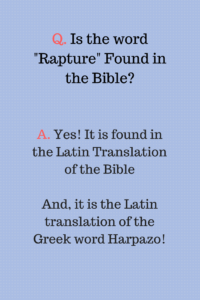
Rapture Question #1: Is the Word “Rapture” Found in the Bible?

As many uninformed people point out, the word “Rapture” does not occur in the “Bible.”  They are only right in the fact that it doesn’t appear in the ENGLISH translation of the Bible. However, It does occur in the Latin translation of the Bible.

The word Rapture comes from the Latin word rapiemur. Raptus is the past participle of rapio, and our English words “rapt” and “rapture” stem from this past participle.1  It appears in the following New Testament verses:

Revelation 12:5  “et peperit filium masculum qui recturus erit omnes gentes in virga ferrea et raptus est filius eius ad Deum et ad thronum eius”
Revelation 12:5  “And she brought forth a man child, who was to rule all nations with a rod of iron:  and her child was caught up unto God, and to his throne.”

2 Corinthians 12:2 “scio hominem in Christo ante annos quattuordecim sive in corpore nescio sive extra corpus nescio Deus scit raptum eiusmodi usque ad tertium caelum”
2 Corinthians 12:2  “I knew a man in Christ above fourteen years ago, (whether in the body, I cannot tell; or whether out of the body, I cannot tell:  God knoweth;) such a one caught up to the third heaven.

12:4 “quoniam raptus est in paradisum et audivit arcana verba quae non licet homini loqui”
12:4  “How that he was caught up into paradise, and heard unspeakable words, which it is not lawful for a man to utter.”

Acts 8:39 “cum autem ascendissent de aqua Spiritus Domini rapuit Philippum et amplius non vidit eum eunuchus ibat enim per viam suam gaudens”
Acts 8:39 “And when they were come up out of the water, the Spirit of the Lord caught away Philip, that the eunuch saw him no more…”

1 Thessalonians 4:17  “deinde nos qui vivimus qui relinquimur simul rapiemur cum illis in nubibus obviam Domino in aera et sic semper cum Domino erimus”
1 Thessalonians 4:17 “Then we which are alive and remain shall be caught up together with them in the clouds, to meet the Lord in the air; and so shall we ever be with the Lord.”

In the original Greek, the word that is translated “caught up” is ἁρπάζω (harpazo), “to take away by force.”  The definition of “Harpazo” is:

1) to seize, carry off by force
2) to seize on, claim for one’s self eagerly
3) to snatch out or away2

Philip is an interesting example of someone being caught away. In Acts 8, there is the account of the Ethiopian Eunuch who was traveling along trying to understand Isaiah 53:7,8.  The Eunuch asked Philip what this passage meant.  After Philip explained it to him, the Eunuch asked to be baptized.  Philip agreed and baptized him, then immediately after the Eunuch was baptized, Philip was “caught away.”

Acts 8:39 “And when they were come up out of the water, the Spirit of the Lord caught away Philip, that the eunuch saw him no more: and he went on his way rejoicing.”

“Caught  away” in this passage uses the Greek word “Harpazo.”  Philip disappeared and then was “found” or “seen to be present” in Azotus. (Acts 8:40).  I think it is an interesting comparison that when we are raptured as believers, WE will be found in the presence of the Lord!

Conclusion: The word “Rapture” and “Harpazo” are found in the Bible.

Footnotes:
1 http://www.khouse.org/articles/2002/444/print/
2 http://www.blueletterbible.org/lang/lexicon/lexicon.cfm?Strongs=G726&t=KJV

Next:  The Rapture Question #2: What does the term “In Christ” mean?

SaveSave

SaveSave

SaveSave

SaveSave

SaveSave

SaveSave

SaveSave


The Queen of Heaven

On December 8, 2010, the first Marian shrine in the United States was approved by the Roman Catholic Church at the Shrine of Our Lady of Good Help in Champion Michigan.  David Ricken, the bishop of the Catholic Diocese of Green Bay, announced his official approval of the Marian apparitions stating:

It remains to me now, the Twelfth Bishop of the Diocese of Green Bay and the lowliest of the servants of Mary, to declare with moral certainty and in accord with the norm of the Church:  That the events, apparitions and locutions given to Adele Brise in October of 1859 do exhibit the substance of supernatural character, and I do hereby approve these apparitions as worthy of belief (although not obligatory) by the Christian faithful.” [emphasis mine.]

The approved site in Champion joins with others such as–Lourdes, France; Guadalupe, Mexico; and the most famous–Fatima, Portugal.

Since the announcement in December, attendance in Champion has been booming.  It is estimated that 500-800 people a day have visited the site since that time.

This Shrine of Our Lady of Good Help in Champion, Wisconsin was featured in an ABC Nightline program July 13, 2011 at 9:00 p.m. called “Miraculous Mysteries.

In an interview, Nightline’s co-anchor, Bill Weir asked Bishop Ricken what criteria was used to determine whether an apparition site is legitimate or not, and asked if it could possibly be demonic interference?”  In answer, Bishop Ricken first referred to 2 Corinthians 11:14, which indicates that Satan can appear as an angel of light, and then stated “I suppose he (Satan) could even fraudulently imitate the blessed mother.

According to the same program, another Marian site is currently being considered for approval, a very famous site in Medjugorje, Bosnia.   In the early 80′s, six children–Ivan, Marija, Ivanka, Jakov, Vicka, and Mirjana began having daily visits by the  Marian Apparition.  They were each promised ten secrets regarding the future of the world.   The daily visits are still continuing for Ivan, Marija, and Vicka.  However, the daily visits ceased for Mirjana, Ivanka, and Jakov once they received the ten secrets.

Because of the fighting between the local Franciscans and the Vatican’s bishop regarding the legitimacy of the apparition and her messages, and also due to the fact that the visionaries claim that the apparition disagrees with the bishop, the Vatican stepped in last year and Pope Benedict XVI sent a commission out to look into Medjugorje.

Dr. Mark Miravalle, a leading Mariologist and one who has investigated other apparition sites for the Church, believes it will pass the Vatican’s test.  He stated:

After 25 or 30 years … the church can have a pretty good idea about whether this is of God, or whether it’s of Satan. The message is very sound. The spiritual fruits are undeniable

But are the messages from the Marian Apparitions sound?   And as Bishop Ricken indicated above, could any or all of the Marian apparitions be demons or Satan himself pretending to be Mary, the mother of Jesus?

Interestingly enough, it is the Marian Apparitions themselves who have provided the answer to these questions…

In many of the messages given by the Marian Apparitions in numerous locations both approved and unapproved, she calls herself the “Queen of Heaven.”

The Queen of Heaven is mentioned several times in the Bible and God makes it very clear that the Queen of Heaven does not have his approval.

Jeremiah 7:18  “The children gather wood and the fathers kindle the fire, and the women knead their dough, to make cakes to the queen of heaven, and to pour out drink offerings unto other gods, that they may provoke me (the LORD) to anger.” (Also see Jeremiah 44:17-19, 25)

Who is the Queen of Heaven?

The Queen of Heaven is just one of many names given the “Goddess of Nature” who has been worshiped from the earliest days to the present, primarily by women.

She is called:

Beltis or Mylitta–by the Babylonians
Ishtar–by the Assyrians
Astarte–by the Phoenicians
Tanata–by the Persians
Isis–by the Egyptians
Shing Moo or Holy Mother–by the Chinese
Aphrodite–by the Greeks
Artemis or Diana–by the Ephesians
Venus–by the Romans
Queen of Heaven– in the book of Jeremiah

It is no coincidence that these Marian Apparitions each call themselves the Queen of Heaven.  If the apparitions are truly of Mary the mother of Jesus, and if they have the abilities that are ascribed to the Marian Apparitions, she would certainly not choose a pagan title for herself.  So it is apparent that a demonic entity (or entities) is indeed impersonating Mary as Bishop Ricken himself indicated was a possibility–-not just certain ones as he assumes–-but ALL of them.