

This is meant to be a work in progress. If you have others, or something needs clarification, or there is an error, please post a response, and I will revise and add to this.
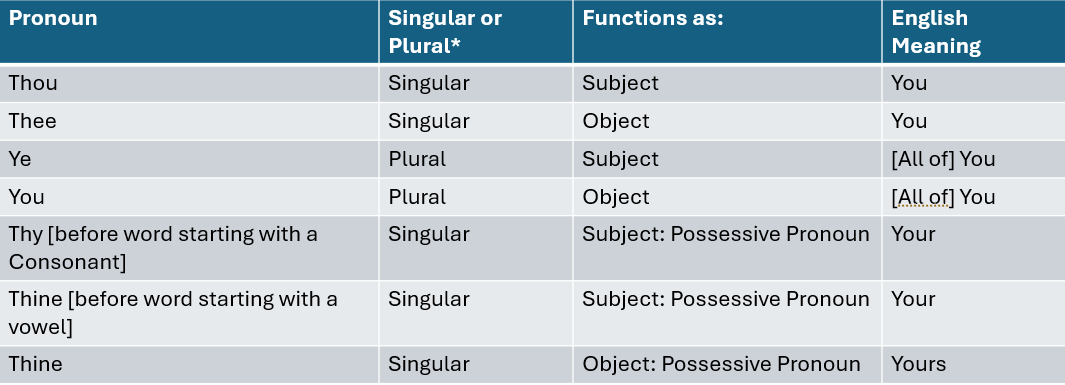
*If it starts with a “T” it is Singular; If it starts with a “Y” it is plural

Using the information above, can you answer the questions regarding this Scripture verse: “And whosoever liveth and believeth in me shall never die. Believest thou this?” [John 11:26]
- Why is the “eth” ending used in liveth and believeth, but the “est” ending is used with Believest thou this?
- Why is “thou” used and not “thee.”
You can put your explanation in the comment section.
English Words that have changed meaning since the KJV was translated
- Allow: Approve or accept, not permit. [Luke 11:48; 1 Thess. 2:4]
- Charity: Refers to Christian love [agape], not just alms-giving. [1 Cor. 13]
- Conversation: Refers to conduct, behavior, or lifestyle. [Phil 3:20; 1 Timothy 4:12; James 3:13]
- Halt: Means lame or crippled, not stopping. [Luke 14:21]
- Instant: Urgent or insistent, not immediate. [Luke 23:23]
- Let: Means to hinder or restrain, the opposite of the modern meaning. [2 Thess. 2:7]
- Meat: Refers to food in general, not specifically flesh. [Romans 14:15; Hebrews 5:14]
- Peculiar: Means special [in a good way], treasured possession, not strange. [1 Peter 2:9]
- Prevent: To come before or precede, not to stop. [1 Thess. 4:15]
- Silly: Originally meant innocent, harmless, or pitiable. [Hosea 7:11]
- Vain: Empty, worthless, or foolish. [Exodus 20:7]
- Wanton Reckless or luxurious, not sexually lewd. [1 Tim. 5:11]
- Wax: To grow or become. [Luke 12:27; Acts 13:46]