

If I were to tell you “Good News! I have chosen you!” What would be your first thought? Most likely you would think or say “Chosen for what?” When used as the main verb of the sentence, “to choose” is a transitive verb, which means that there must be a direct object as in “I have chosen you to teach the Sunday School class.” Or you could say, “I have chosen you for a higher purpose.”
If there is no direct object, you can’t just assume the subject matter, unless I had just said something like “I decided to choose someone to teach the Sunday School class. Good News! I’ve chosen you! [in other words, you are that “someone” that I chose.]
What if I was in front of a class and I said “Good News! I have chosen all of you in this class to go ice skating on Friday. Who would this apply too? Everyone who was in the classroom when I said this, and presumably anyone who is a student in the class who happens to be absent that day.
What about the people in the hallways, outside or in a different class, were they chosen to go ice skating? No, only everyone “in this class.” “In this class” is a prepositional phrase further describing “you.” It is an important prepositional phrase because it narrows down who this applies to.
An important prepositional phrase in the following verse is often ignored or misrepesented by reading a theological idea into this verse without any basis for doing so.
Ephesians 1:4 “even as he chose us in him before the foundation of the world, that we should be holy and blameless before him.” [ESV]
God chose us. As in our example, what did God choose us for? In this case, “chose” is a transitive verb requiring a direct object. He chose us [for the purpose] that we should be holy and blameless before him.
The second prepositional phrase answers the question “When” he did this–“before the foundation of the world.”
The very important preposition phrase [although only two words] “in him” is ignored. “In him” modifies “us.” God planned beforehand that all those ALREADY in Christ Jesus…
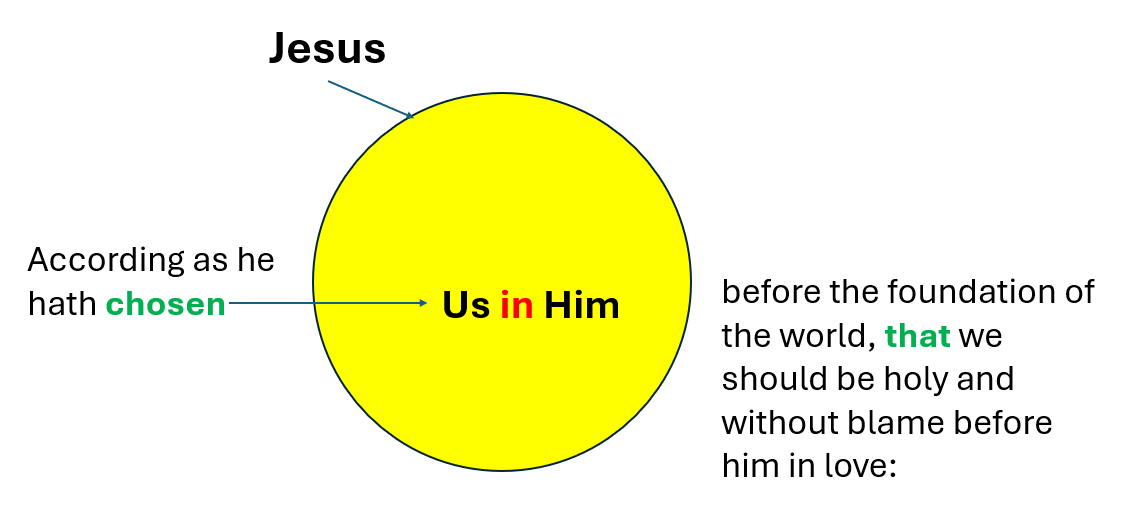
…would be blessed with every spiritual blessing in the heavenly places: [Eph. 1:3]
- He chose US who are already In Christ Jesus to be holy and blameless before Him [Eph. 1:4]
- He planned in advance that we who are already In Christ Jesus would be “placed as sons” AT THE REDEMPTION of our body. [Eph. 1:5]
- He planned in advance that we who are already In Christ Jesus would obtain an inheritance [Eph. 1:11]
- He planned in advance that we who are already in Christ Jesus would be sealed with the promised Holy Spirit, UNTIL we acquire possession of our inheritance. [Eph. 1:13-14]
God also planned in advance to unite all things in Christ: [Eph. 1:10]
- To set Christ far ABOVE all things: All rule, authority, power, and dominion and above every name that is named not only in this age, but the age to come [Eph. 1:20-21]
- To put everything UNDER his feet. [Eph. 1:22]
- To be the HEAD of the Church, which is his body–the fullness of him who fills all in all [Eph. 1:23-24]
“In Christ Jesus” means: Those who have redemption through Christ’s blood, who heard the word of truth, the gospel of their salvation and believed in him. [Eph. 1:13]
CONCLUSION: There is nothing in Ephesians Chapter One that states anyone who is unbeliever was chosen TO BE saved.
________________________________________
Note: Calvinists believe unbelievers are chosen to be saved. Arminians believe God chose to save those he foreknew would believe in him. Neither are correct. Although the Arminian view is closer. Yes, he knew who would believe in Jesus and who would not, but he didn’t choose them TO BE saved. He chose those who did believe in Christ Jesus, thus being “In” Christ Jesus, TO BE holy and blameless before him and to receive all spiritual blessings.
You will often hear Calvinists say something like: “the debate between Calvinism and Arminianism has been going on for hundreds of years, and will never be solved–they will never come to an agreement.” In my opinion, that is true, but the reason is they are both wrong! If I say 2 + 2 = 5 and you say 2 + 2 = 7, of course we will never agree on either one, because they are both wrong.